The kids are teaching us to make what we do count, big and small.
Thumbs up to class 5B! :)
A few inspiring words from the Doers themselves:
Hello World!
We are 22 happy students in 5B at Genarps school in Sweden.
We would like to save the polar bear and the rest of the planet. We switched off the lights and other things that require electricity for one whole day (Earth day) in our classroom, to save energy. Instead we lit candles or went outside to work in daylight.
Kipepeo means butterfly in Swahili and the Butterfly Pavillion is based in the Arabuko Sokoke Forest.
The Kipepeo Project is a community based enterprise which formed to change the local attitude towards an incentive to the conservation of the forest as well as a means to make a livelihood. The community members export around 50.000 butterfly and moth pupae around the world and the project is an example of how linking conservation and development can be a success.
At Gede Snake Park our bear takes a close look at a twig snake
by Sandra Asubila
Arabuko Sokoke Forest is the most intact coastal forest in East Africa and one of the last remnant indigenous forests in Kenya. The forest is threatened by the desire for land by local people. Several national and international conservation organisations are working with the Kenya Wildlife Service to protect the park.
Read more about the conservation and management project of Arabuko Sokoke Forest.
Sustainable fishing guarantees there will be population of ocean and freshwater wildlife for the future.
You can read more about MaMa, the Malindi Marine Association, and their work to preserve their thousand year practice of sustainable fishing and how it also sustains their livelihood.
to introduce sustainable, integrated urban environment planning and management.
The biodiversity in this coastline area is what attracts tourists (both international and domestic) and the realisation that the destruction of the ecosystem will destroy the attraction has led to an upswing in eco-tourism. Waste management is taken into consideration as well as the conservation of natural and cultural heritages.
From Matemwe Zanzibar with Love! by Erik Brattström
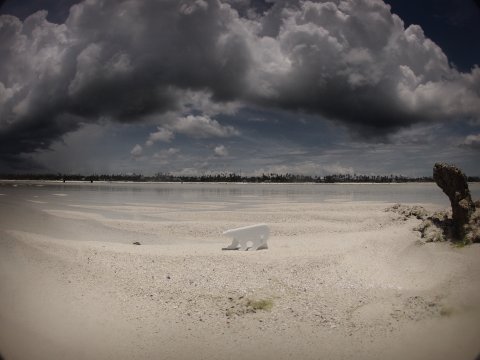
Mr. Bear-ly's journey on the east coast of Africa continues and it
looks like he's seeing first hand what land might look like under the sea...
The island of Zanzibar off the east coast of Tanzania,
experience erratic weather extremes, due to the climate change,
such as flood and drought which impacts negatively on the island's economy as well as ecosystem.
Efforts are being made to focus on necessary adaptation solutions to adjust to future impacts.
Malindi, situated on the coast of Kenya, is a popular tourist destination.
Efforts are made to combat the social impacts of climate change by promoting sustainable tourism and preserving the mangrove trees (trees and shrubs that can grow in salinated water) to help with climate change mitigation.
Our very first bear-ly sighting from the continent of Afrika!
How fitting that the bear should visit the coastal city of Maputo, capital of Mocambique, as it is one of the coastal cities with high risk of flooding and combats daily to prevent the erosion of its coastline due to the present effects of climate change.


.JPG)
.JPG)
.JPG)
.JPG)
.JPG)
.JPG)


.JPG)